Symptoms & causes · The puddle on the floor
Sub-Zero Leaking Water in St. Augustine
A puddle under a built-in is rarely the refrigeration. It is almost always plumbing — and on an old-city hardwood floor, the sooner it is found, the cheaper it stays.
A leaking Sub-Zero in St. Augustine is usually a clogged defrost drain backing meltwater onto the floor, a cracked ice-maker or dispenser water line, or a scaled inlet valve that no longer seals on our hard aquifer water. Most leak repairs run $250 to $700, source confirmed before any quote. A steady drip from a pressurized line is a same-day call — (904) 892-7163 or book online.
For Sub-Zero repair across St. Augustine — from Davis Shores to World Golf Village — call the old city line at (904) 892-7163 or book online.
Updated June 13, 2026
Before anything else
St. Augustine Sub-Zero Repair is an independent Sub-Zero repair company in St. Augustine, Florida (ZIP 32084), reachable at (904) 892-7163 or through an external online booking page. A leak has several possible sources, so we find the right one before we quote — never a guess at the price.
Why is my Sub-Zero leaking?
Most often a clogged defrost drain sending meltwater to the floor, a cracked water line, or a scaled ice-maker inlet valve. Each is a different fix. Call (904) 892-7163 and describe where the water shows up — floor, ice bin, or between the doors.
What will the repair cost?
A defrost-drain clear runs $250 to $550; a cracked line or scaled valve runs $250 to $700 with parts. We confirm the source on site and put a firm number in writing before any work begins.
Is it urgent?
A pressurized water-line drip is a same-day call — it does not stop on its own and soaks old flooring fast. A slow defrost-drain puddle is a same-week repair. Either way, keep towels down and the water off the cabinet base until we arrive.
The record
The leak facts behind most St. Augustine puddle calls.
- A clogged defrost drain is the single most common leak — meltwater that cannot reach the evaporation pan finds the floor.
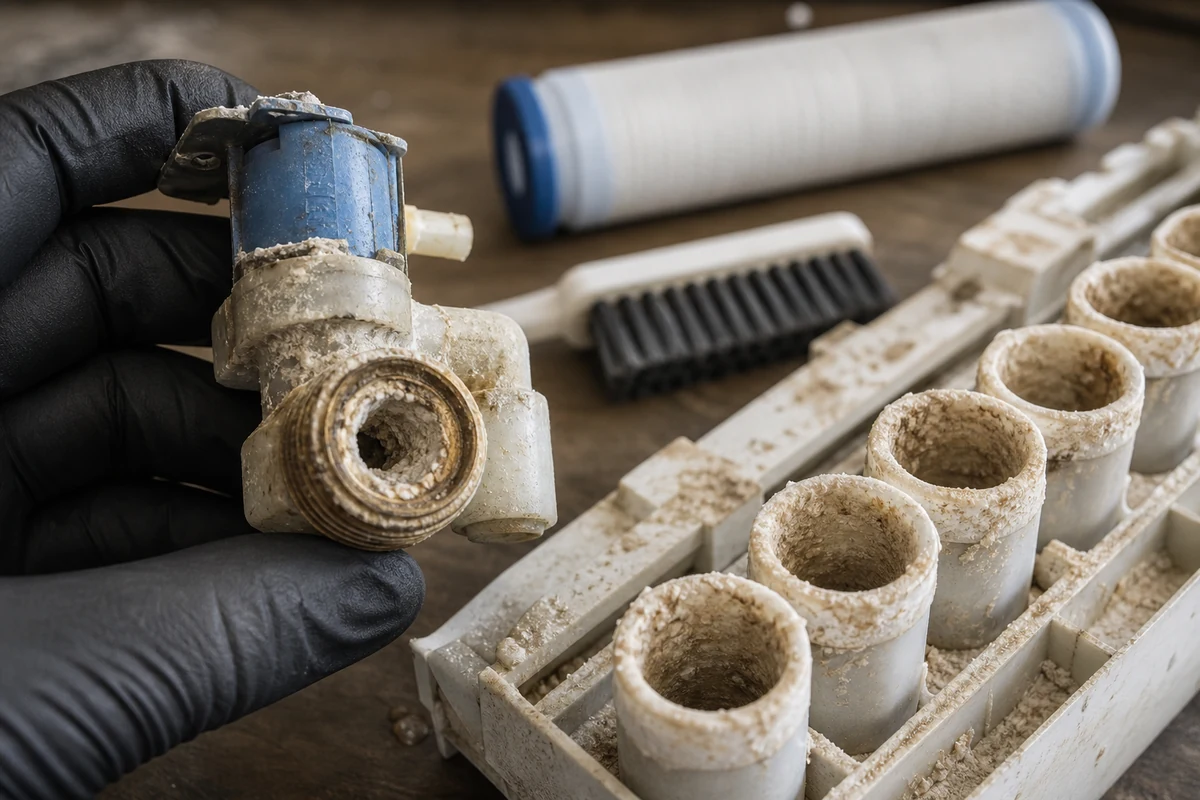
- 14–28 grains per gallon of aquifer hardness scales inlet valves and fittings until they no longer seal.
- Pressurized water-line leaks do not stop on their own — treat a steady drip as same-day.
- Mullion condensation between the doors is a heater or gasket fault, not a drain — a separate, common coastal-humidity complaint.
- Never force wire down a drain line — puncturing the pan or tubing turns a small repair into a large one.
- Humid St. Augustine summers push the defrost cycle harder, so a partial clog that coped in winter overflows in August.
Where the water is really coming from
A leak is a detective problem before it is a repair. Water travels along the cabinet base and shows up far from its source, so the first job is to read where it actually appears — floor, ice bin, dispenser tray, or the seam between the doors — because each points at a different fault and a different price.
Floor water under the unit is usually the defrost drain. Every Sub-Zero defrosts on a cycle, and that meltwater is meant to run a small line to a pan near the compressor and evaporate away. Ice, sludge, or our hard-water scale closes that line, the pan overflows, and the floor gets the difference. Clearing and reheating the drain is the common cure.
Water at the ice bin or dispenser is the plumbed side — a cracked supply line, a worn or scaled inlet valve, or a fill tube overshooting the mold. That is the same hard water that slows ice production, covered on our ice-maker page and the Palencia ice-maker page.
Where the water appears, and what it means
| Where you see water | Most likely source | Likely cost lane |
|---|---|---|
| Puddle on the floor under the unit | Clogged or iced defrost drain | $250–$550 |
| Water in or under the ice bin | Cracked supply line or fill-tube overshoot | $250–$700 |
| Dripping at the dispenser tray | Scaled or worn water inlet valve | $250–$700 |
| Moisture between the two doors | Mullion heater or gasket fault | $250–$700 |
| Water pooling inside the fresh-food floor | Drain trough iced over behind the panel | $300–$650 |
What is safe to check before you call
A few gentle steps narrow the cause and sometimes stop the water entirely. None of them risks the unit; the one rule is no sharp tools down the drain line.
- Note exactly where the water shows up. Floor, ice bin, dispenser, or between the doors — that single observation points us at the right system before we arrive.
- Check the water-line shutoff. If the leak is plumbed-water and steady, the shutoff behind or below the unit stops it until the visit and protects the floor.
- Thaw a light drain clog gently. Clear ice from the freezer floor and pour a little warm water down the visible drain opening — never wire or a coat hanger.
- Inspect the gasket seal. A door that will not seat lets humid air in, frosts the coil, and overloads the drain. A dollar-bill drag test shows a tired gasket.
- Keep it dry underneath. Towels under the unit protect old-city hardwood and toe-kicks while you wait — standing water and Florida humidity invite mildew quickly.
Why leaks read differently across St. Augustine
The plumbed-water leaks track our aquifer. In the Palencia and CR-210 corridor, where hardness runs at the high end, inlet valves and fittings scale and stop sealing sooner, so cracked-line and valve leaks show up more often than they do on softer supplies. The same scale that slows the ice maker is what eventually weeps at the valve.
The defrost-drain leaks track humidity and history. Coastal homes on Anastasia Island and in Davis Shores drive the defrost cycle hard through the summer, so a partial clog overflows there first. And on the post-flood rebuild cohort, a unit that stood in saltwater in 2016 or 2017 can carry corrosion at a drain pan or fitting that surfaces now as a slow weep — the longer history is on our after-the-flood field guide.
Leaking-water questions owners ask
Why is my Sub-Zero leaking water onto the floor?
The most common cause by far is a clogged defrost drain. Meltwater from the normal defrost cycle is supposed to run down a small drain line to a pan near the compressor, where it evaporates. When that line ices up or sludges shut, the water backs up and finds the floor instead. On units with plumbed ice makers and dispensers, a cracked water line or a failed inlet valve is the other usual suspect — and on our hard water, mineral scale plays a role in both.
Is a small puddle under my Sub-Zero an emergency?
Not a panic, but do not let it sit. Standing water under a built-in seeps into cabinet toe-kicks and historic-home flooring, and in St. Augustine’s humidity that invites mildew fast. A defrost-drain clog is a same-week repair; a steady drip from a pressurized water line is a same-day call, because that one does not stop on its own and can do real damage to old wood floors overnight.
Could the leak be coming from the ice maker?
Often, yes — and that points back to our water. A leaking ice maker usually traces to a cracked supply line, a worn or scaled water inlet valve, or a fill tube that overshoots the mold. St. Johns County aquifer water runs 14 to 28 grains per gallon, so scale builds on valves and fittings and eventually keeps them from sealing. The full hard-water story is on our ice-maker pages.
Can I fix a clogged defrost drain myself?
Gentle steps only. You can clear the freezer of ice buildup over the drain and pour a little warm water down the visible drain opening to thaw a light clog. What you should not do is jam wire or sharp tools down the line — you can puncture the drain pan or the tubing and turn a $300 repair into a much larger one. If warm water does not restore the flow, the clog is deeper and the unit needs to come apart properly.
Why do Sub-Zero leaks seem worse in St. Augustine’s humid months?
Humidity drives the defrost cycle harder. The more moist air that enters the cabinet every time a door opens, the more frost the evaporator collects and the more meltwater the defrost cycle has to drain. In a Florida summer that volume is real, so a drain that is only partly clogged stays ahead of the water in winter and overflows in August. Coastal homes near the water see it first.
What does it cost to fix a leaking Sub-Zero?
A defrost-drain clear or a drain-heater repair usually lands between $250 and $550. A cracked water line or a scaled inlet valve runs roughly $250 to $700 with parts. A drain pan or a more involved evaporator-area repair can reach the middle band. We confirm the source first and quote a firm number in writing before any work — a puddle has several possible causes and we will not guess at the price.
Water is pooling between the two doors, not on the floor. Is that the same problem?
No — that is mullion condensation, and it is a different fix. The mullion is the strip between a side-by-side or french-door pair; when its anti-sweat heater fails or a gasket lets humid air past, moisture condenses there and drips. In our coastal humidity it is a fairly common complaint. It points to a gasket or a mullion-heater fault rather than a drain, and we check those before opening the cabinet floor.
Could a leak under my older built-in be a sign of something worse?
Usually not — most leaks are drains and water lines, the cheap end of the ladder. But on a unit that flooded in 2016 or 2017 and was put back into service, we look a little harder, because saltwater intrusion years ago can leave corrosion that shows up now as a weeping fitting or a rusted pan. We tell you plainly if a leak is cosmetic plumbing versus the first sign of a deeper problem.
Every page on this site
The full set of repair, series, and neighborhood pages for St. Augustine Sub-Zero owners.
Durable things deserve care.
Tell us the model and the symptom, and we will arrive with the right parts the first time.