Repairs · Hard water & ice
Sub-Zero Ice Maker Repair in St. Augustine
Our water comes up through limestone, and limestone is patient. It closes a fill valve so slowly the owner doesn’t notice until the bin runs dry.
We repair Sub-Zero ice makers across St. Augustine, where the Floridan aquifer runs 14 to 28 grains per gallon — very hard. Scale on the fill valve and mold is the leading cause of shrinking harvests here. Descaling, valve rebuilds, and filter service usually restore full output, with most repairs running $200 to $700.
For Sub-Zero repair across St. Augustine — from Davis Shores to World Golf Village — call the old city line at (904) 892-7163 or book online.
Updated June 13, 2026
Before anything else
St. Augustine Sub-Zero Repair is an independent Sub-Zero ice-maker service company in St. Augustine, Florida (ZIP 32084), reachable at (904) 892-7163 or through an external online booking page. We service built-in ice makers and the UC-15I undercounter machine, not as factory service but as the local specialists who know this water.
Who services Sub-Zero ice makers in St. Augustine?
St. Augustine Sub-Zero Repair does, across the 32084, 32080, 32095, and 32092 ZIP codes — Palencia, Anastasia Island, and World Golf Village included. Call (904) 892-7163 or book online; we start with the water path before condemning the unit.
What does an ice-maker visit cost?
A diagnostic visit confirms whether the fault is scale, a valve, a filter, or the harvest cycle, and ends with a written number. Most ice-maker repairs run $200 to $700; a full inlet-valve replacement on a scaled unit sits at the top of that range.
What if it’s the source water, not the machine?
We test before we charge. If a spent filter or a fouled supply line is flavoring the ice, that is a quick fix — not a valve. Honest diagnosis is the whole point of starting at the water.
The record
The hard-water facts behind most St. Augustine ice-maker calls.
- 14–28 grains per gallon is the local Floridan-aquifer hardness — among the highest in Florida, with the peak near St. Johns Forest.
- Scale on the fill valve is the most common reason a harvest shrinks; the valve opens less with every passing month.
- Roughly every six months is the filter interval; on this water, four to five months serves heavy ice users better.
- The UC-15I undercounter machine needs periodic descaling of its evaporator plate and a clear gravity drain to keep output up.
- $200–$700 covers most ice-maker repairs — descaling, screens, filters, and valve work.
How hard water actually kills an ice maker
The fill valve closes by degrees
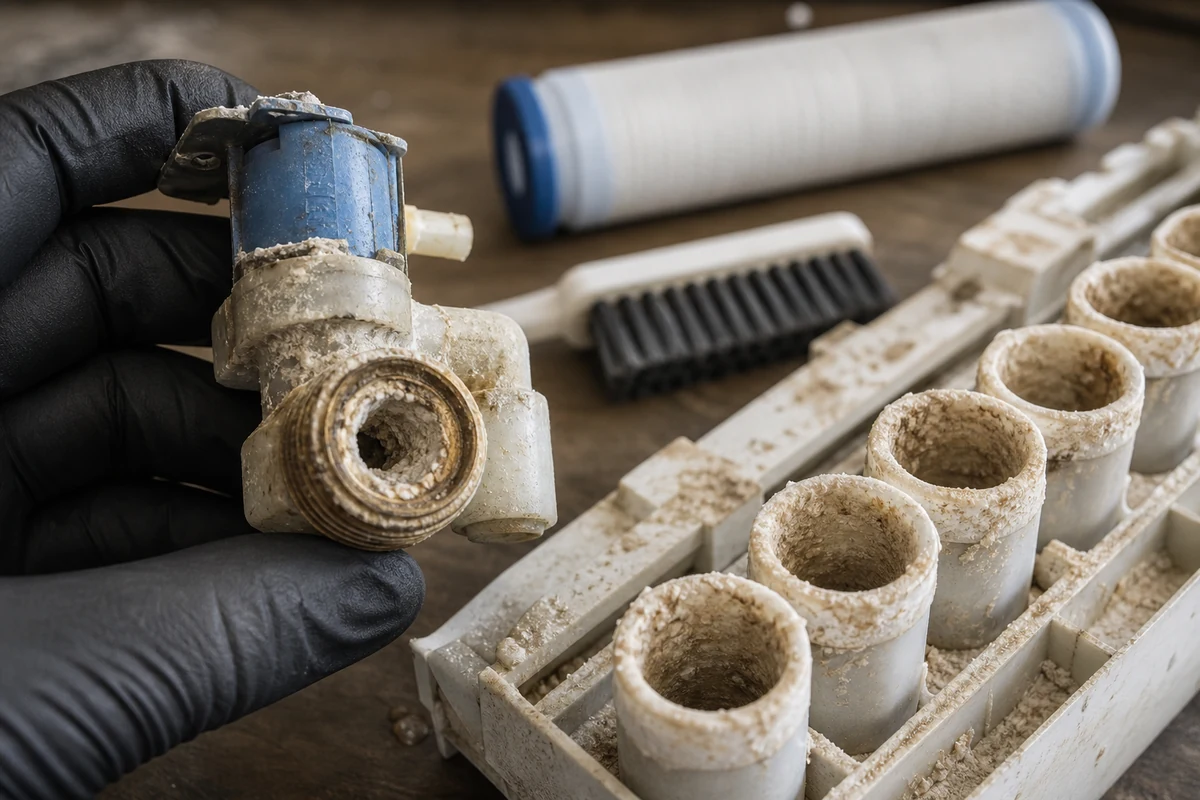
Every harvest, the inlet valve meters a measured slug of water into the mold. Minerals settle on the valve seat and the inlet screen, and the opening narrows. The mold under-fills, cubes come out hollow or half-size, and eventually the harvest stops. A rebuild or new inlet valve, plus a thorough descale, brings the output back.
The mold and harvest cycle scale up
Scale also crusts the mold and the harvest heater, so cubes stick and the cycle stalls. On built-ins we clean the mold, verify the thermistor and harvest timing, and confirm a clean ejection before sign-off. The 600 and BI ice makers each have their own harvest quirks, covered on our BI series page.
The undercounter UC-15I in a humid garage
Resort-grade undercounter ice machines along the coast face the worst of both worlds: hard water and humid, salty air in a tight cabinet. The UC-15I’s evaporator plate scales and its gravity drain clogs. We descale the plate, clear the drain, and check the condenser that the cabinet keeps starved of air.
Leaks and stuck-open valves
When scale wedges a valve partly open, water seeps after the fill cycle should have ended and pools beneath the unit. We pressure-check the line, replace the valve seal, and watch a full cycle finish dry. Many of the leak calls we run in Palencia begin exactly this way.
Symptom, first check, and likely cost lane
| What you see | First thing we check | Likely cost lane |
|---|---|---|
| Harvest shrinking, cubes hollow | Inlet-valve scale and the fill-cycle water volume | $200–$550 |
| Off taste or smell in the ice | Filter age and the supply-line condition | $200–$400 |
| Water pooling under the unit | Inlet-valve seal and the fill-tube path | $350–$700 |
| UC-15I output dropping | Evaporator-plate scale and the gravity drain | $300–$700 |
| No ice at all, cycle stalled | Harvest heater, thermistor, and mold scale | $400–$1,100 |
What keeps an ice maker alive on this water
Most ice-maker grief here is preventable, and the prevention is cheap compared to a valve replacement. We leave owners with a short maintenance rhythm tuned to St. Johns County water.
| Habit | What it protects | How often here |
|---|---|---|
| Replace the water filter | Fill valve and inlet screen from scale | Every 4–6 months for heavy ice users |
| Descale the mold or evaporator plate | Harvest size and cycle reliability | Annually, sooner on undercounter UC-15I |
| Flush the supply line | Taste, odor, and valve seals | At each filter change |
If the unit is still under factory warranty
Sub-Zero® units from the current CL and DET/DEC generation — late 2022 onward — usually carry factory coverage, and Factory Certified Service should be your first call. We will point you there rather than open a unit we shouldn’t.
Out of warranty, the ice maker is ours: descaling, valve work, undercounter service, and the filter discipline that the hard water here demands.
What an ice-maker service visit includes, step by step
On St. Johns County water, we treat the whole water path, not just the ice maker, because the fault almost always sits upstream of the cubes. Working it in sequence keeps a $200 descale from being mistaken for a $700 valve job, or the reverse.
- Confirm supply and pressure. A pinched saddle valve or low line pressure starves the fill before any scale is to blame.
- Inspect the inlet valve and screen. Mineral scale on the seat and the inlet screen is the leading restriction on 14–28 gpg water.
- Measure the fill volume. A timed fill tells us whether the mold is getting the water it needs or starving by degrees.
- Run a full harvest. We watch the cycle, the harvest heater, and the thermistor to confirm the cubes release cleanly instead of sticking to a scaled mold.
- Check the filter and flush the line. A spent filter or stagnant supply gets replaced and flushed before the off-taste is blamed on the machine.
- Quote, repair, and confirm dry. After valve or descale work we watch a cycle finish dry so a stuck-open valve never leaves a leak behind.
Built-in ice maker versus the UC-15I undercounter machine
The two ice systems we service here fail in different ways, and the cure differs accordingly. A built-in ice maker lives inside a cold 600, BI, or Designer cabinet; the UC-15I is a standalone machine that often sits in a hot, humid coastal garage or summer kitchen.
| Aspect | Built-in ice maker (600 / BI / Designer) | UC-15I undercounter machine |
|---|---|---|
| Where it lives | Inside the refrigerated cabinet | Standalone cabinet, often a garage or summer kitchen |
| Leading fault here | Scaled inlet valve, shrinking harvest | Evaporator-plate scale and a clogged gravity drain |
| The extra coastal stressor | Hard water alone | Hard water plus salty, humid air starving the condenser |
| Typical service | Valve rebuild, mold descale, filter discipline | Plate descale, drain clearing, condenser cleaning |
The undercounter machine’s starved condenser is the same salt-and-cabinet story told on our condenser corrosion page, and the BI built-in notes cover the inlet-valve wear in more detail.
Ice-maker questions owners ask at the door
Why does my Sub-Zero ice maker keep slowing down here?
The water. The Floridan aquifer under St. Johns County runs very hard — 14 to 28 grains per gallon — and that mineral load slowly scales the fill valve, the inlet screen, and the mold itself. The valve opens less each month until the harvest shrinks to a few hollow cubes. Descaling, a valve rebuild, or a fresh filter usually restores full output.
My ice tastes or smells off. Is the ice maker broken?
Often the ice maker is fine and the water path is the culprit. A spent filter, a fouled supply line, or stagnant water in a unit that has not cycled in a while will all flavor the cubes. We flush the line, replace the filter, and sanitize the mold. If the off taste persists, we test the source water and the valve seals next.
There is water pooling under the ice maker — what failed?
A leak under the unit usually means the water inlet valve solenoid is not fully closing, a fitting has loosened, or the fill tube has frozen and overflowed. Hard-water scale is a common reason a valve sticks partly open. We pressure-check the supply, replace the valve if its seal is shot, and confirm the fill cycle ends dry before we leave.
How often should the filter be changed on St. Augustine water?
Sub-Zero suggests roughly every six months, but on our hard water many units do better on a tighter schedule — every four to five months for households that use a lot of ice. A clean filter protects the fill valve and the mold from scale, so it is the cheapest maintenance you can do for an ice maker here.
Do you service the UC-15I undercounter ice machine and built-in ice makers?
Yes, both. The UC-15I undercounter ice machine is especially scale-prone on this water and needs periodic descaling of its evaporator plate and a clear gravity drain. Built-in ice makers inside the 600, BI, and Designer boxes get valve, mold, and harvest-cycle service. We carry the common inlet valves and screens on the van.
How can I tell scale apart from a frozen fill tube when the harvest drops off?
Watch one full cycle. A scaled inlet valve meters too little water from the start, so cubes come out hollow or half-size every time, gradually. A frozen fill tube usually follows a defrost or airflow problem and produces normal cubes until it suddenly stops with a tube of solid ice. Steady shrinking points at scale and the valve; an abrupt stop points at the fill tube and the freezing around it.
Would a whole-house water softener make my Sub-Zero ice maker last longer?
It helps the valve and the mold meaningfully, since softened water carries far less of the 14-to-28-grain mineral load that scales the inlet seat. The trade-off is taste and the sodium softeners add, so many owners route the refrigerator and ice line through a dedicated filter instead. We can advise based on your supply, but either path slows the scaling that drives most ice-maker calls here.
Why does the ice maker work fine for a few weeks after I clean it, then slow again?
Because cleaning the visible mold does not touch the scale narrowing the inlet-valve seat and the screen upstream. On this hard water those mineral deposits rebuild quickly, so output returns briefly, then fades. A proper descale of the valve and screen, or a valve rebuild, fixes the upstream restriction that surface cleaning misses. That is the difference between a temporary improvement and a lasting one.
Every page on this site
The full set of repair, series, and neighborhood pages for St. Augustine Sub-Zero owners.
Durable things deserve care.
Tell us the model and the symptom, and we will arrive with the right parts the first time.