Symptoms & causes · What the ocean leaves behind
Sub-Zero Condenser Corrosion & Salt-Air Rust
Stand on the Bridge of Lions on a breezy day and you can taste it. The same air settles on the one part of your refrigerator that has to breathe.
Salt air corrodes Sub-Zero condenser fins across coastal St. Augustine — Anastasia Island, Vilano Beach, and the downtown waterfront — insulating the coil so run times stretch and EC 50 codes appear. Most cases are a cleaning-and-service job, $250 to $550. Replacement is reserved for corrosion that has reached a refrigerant line.
For Sub-Zero repair across St. Augustine — from Davis Shores to World Golf Village — call the old city line at (904) 892-7163 or book online.
Updated June 13, 2026
Before anything else
St. Augustine Sub-Zero Repair is an independent Sub-Zero repair company in St. Augustine, Florida (ZIP 32084), reachable at (904) 892-7163 or through an external online booking page. Coastal condenser corrosion is one of our three defining local repairs, alongside hard-water scale and storm-surge boards.
Who handles salt-corroded Sub-Zeros in St. Augustine?
St. Augustine Sub-Zero Repair does, with the heaviest demand on Anastasia Island and along Vilano Beach where the salt load is highest. We clean, service, and where needed replace corroded parts. Call (904) 892-7163 or book online.
What does corrosion work cost?
A condenser cleaning and fan service runs $250 to $550 and resolves most coastal calls. Replacing corroded hinges, trim, or a fan sits in the mid band; sealed-system damage from corrosion runs $1,500 to $3,000 and is quoted only after a refrigerant-side inspection.
What if the corrosion reached the sealed system?
We confirm a refrigerant-side breach with pressure and frost-pattern evidence before quoting the larger repair — never on a guess. The full sealed-system account lives on our classic-series page.
The record
The corrosion facts behind coastal St. Augustine calls.
- Within ~1 mile of the ocean, condenser fins corrode in three to five years versus a decade or more inland.
- Quarterly cleaning is our coastal recommendation, against Sub-Zero’s baseline of every six to twelve months.
- 3–4 years is how long a door gasket lasts near the water before it hardens — roughly half its inland life.
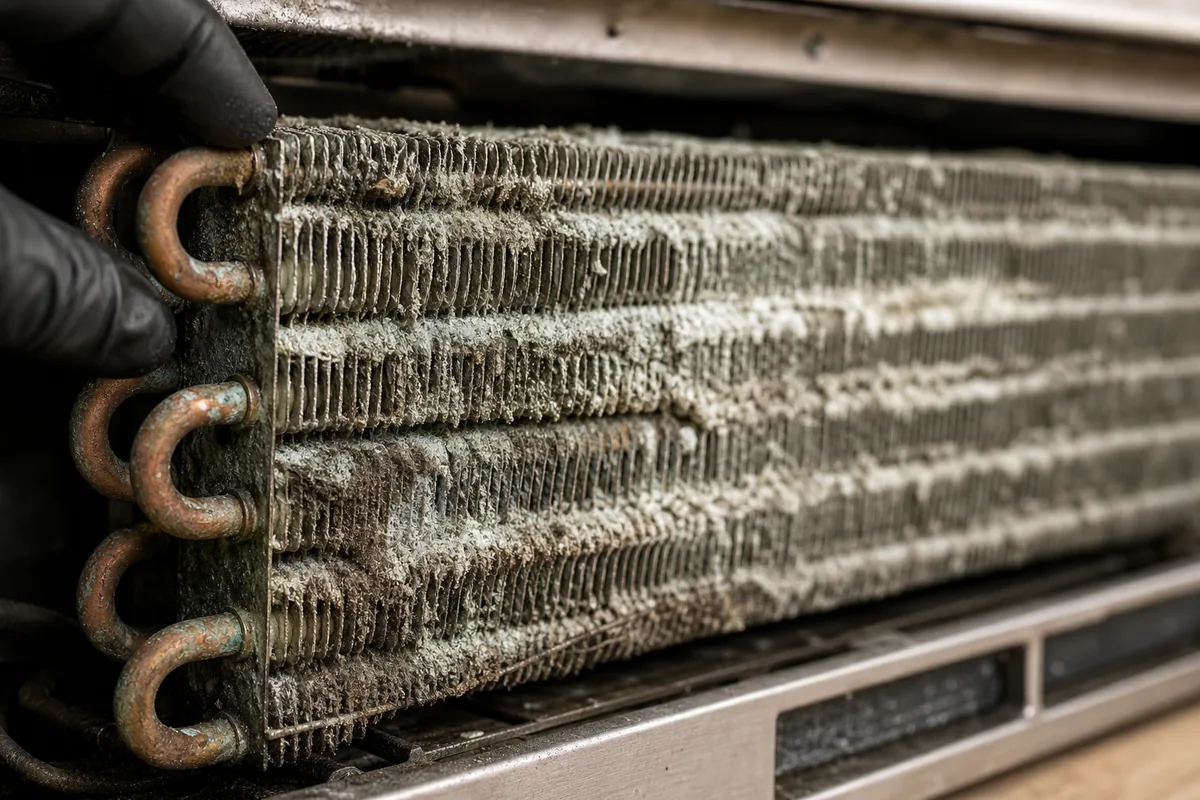
- White-green crust on the fins behind the kickplate is salt oxidation insulating the coil — the most common coastal finding.
- EC 50 is the code a fouled condenser eventually throws, flagging excessive refrigerator-side run time.
How salt turns into a warm refrigerator
A condenser is a finned coil that dumps the heat the refrigerant absorbs inside the cabinet. It only works if air moves freely across clean metal. Salt air does two things to that arrangement, and both are slow until they are sudden.
First, salt crystals and humidity build a pale crust on the aluminum fins. That crust insulates — heat can no longer escape, so the compressor runs longer to hit the same temperature. Run time climbs through spring, the unit struggles through July, and one humid week it posts an EC 50 or simply gives up holding 38°F.
Second, salt attacks the exposed hardware around the coil — the fan housing, fasteners, hinge pins, and grille trim. These are replaceable parts, and replacing them is far cheaper than the run-time wear a neglected coil inflicts on the compressor. When a corroded condenser has already pushed a unit into a warm-box failure, the refrigerator repair workflow takes over from there.
The four signs we look for first
From Vilano Beach down the length of Anastasia Island, the symptoms repeat. If you can spot them early, the fix stays in the cleaning band instead of the compressor band.
- The compressor runs nearly all day and the grille area blows warm to the hand.
- A Service light or EC 50 message appears after every humid spell, then clears in cooler weather.
- White-green crust sits on the fins and fan housing behind the kickplate.
- Food temperatures drift upward each summer and recover each winter — a seasonal corrosion tell.
What you see, what we check, and the lane it points to
| What you see | First thing we check | Likely cost lane |
|---|---|---|
| Crust on the fins, long run times | Condenser cleanliness and airflow across the coil | $250–$550 |
| Condenser fan noisy or seized | Fan motor bearings and corroded mounting hardware | $300–$650 |
| Rusted hinges or grille trim | Hardware condition and door alignment | $250–$600 |
| Gasket hardened and pulling away | Seal compression and the magnet strip | $300–$700 |
| Oil film near a corroded line | Sealed-system pressures and leak location | $1,500–$3,000 |
Corrosion extent, evidence, and the repair decision
| Corrosion extent | Evidence we gather | Service decision |
|---|---|---|
| Surface crust on the fins only | Fin condition after cleaning, restored airflow | Clean and service; unit returns to spec |
| Hardware and trim attacked | Fasteners, hinges, fan housing inspected | Replace corroded parts; cabinet stays |
| Fin pack thinned and brittle | Heat-shedding capacity under load | Coil service now, watch for recurrence |
| Refrigerant line breached | Pressure test and oil-trace at the leak | Sealed-system repair, quoted firm |
A coastal condenser calendar for St. Augustine
Salt does its work on a seasonal rhythm here, and so does the care that holds it off. This is the cadence we keep for units within reach of the water, from Vilano Beach down through Anastasia Island.
| Season | What the salt is doing | What the visit covers |
|---|---|---|
| Spring (Mar–May) | Crust from winter sea fog insulating the fins | Deep coil clean before the cooling load climbs |
| Summer (Jun–Aug) | Peak run times; a fouled coil tips into EC 50 | Airflow check, fan service, temperature verification |
| Fall (Sep–Nov) | Storm-season surge risk on top of salt load | Coil clean plus a board and gasket inspection |
| Winter (Dec–Feb) | Lower load masks a coil that is quietly failing | Hinge and trim hardware check, gasket compression |
On a healthy box this is preventive housekeeping, not repair. The same condenser discipline keeps a warm-box failure from ever starting — the diagnostic side of which is the refrigerator repair workflow.
The math on a coil cleaning versus the repair it prevents
A worked example from the island side makes the case plainly. Take a BI-36U a few blocks off the beach on Anastasia.
On a quarterly schedule, four condenser cleanings across the year run in the $250 to $550 band each visit, and the unit holds 38°F through August without strain. Skip the schedule, and the salt crust thickens, run times stretch through spring, and the unit posts an EC 50 by July. Now the same coil clean shares a ticket with an overworked condenser fan ($300 to $650) — and if the long run times have leaned on a tired compressor, the bill can climb toward the $1,000-to-$2,000 compressor lane or, where corrosion finally breaches a refrigerant line, the $1,500-to-$3,400 sealed-system lane.
The standing schedule is the cheaper path by a wide margin, and it keeps the expensive parts of the machine — compressor, coils, sealed system — out of the conversation entirely. The repair-versus-replace numbers on a unit that did reach the sealed system are on our classic 500 and 600 series page.
Living with salt air in the old city
The waterfront mansions along the Matanzas often hold two or three refrigeration units plus wine storage, and a summer kitchen with an undercounter box facing the breeze. Those outdoor and garage units take the worst of it — direct salt exposure with no conditioned air to slow the corrosion. We service them on a season-by-season cadence rather than waiting for the failure.
Anastasia Island and Vilano Beach homes a few blocks back are not spared either; the salt carries well inland on the prevailing wind. The honest answer for any coastal owner here is a standing condenser schedule. It is the cheapest insurance in the kitchen, and it keeps the run-time damage from ever reaching the compressor. Owners along Davis Shores and Anastasia Island are our most frequent corrosion calls; the inland World Golf Village cohort fails more by age than by salt.
Corrosion questions coastal owners ask
How fast does salt air really corrode a Sub-Zero condenser near the water?
Faster than the manuals assume. Within roughly a mile of the ocean — much of Anastasia Island and Vilano Beach — we see condenser fins develop a pale crust and lose heat-shedding ability inside three to five years, against a decade or more inland. Door gaskets harden in three to four years instead of seven or eight. The salt does not pause between storms; it works every humid afternoon.
Is a rusty-looking condenser a sign I need a new refrigerator?
Almost never. Surface corrosion on the condenser fins is a cleaning-and-service problem, not a death sentence. We comb and clean the fin pack, service the condenser fan, and the unit usually returns to spec. We only flag replacement when corrosion has eaten through a refrigerant line or the sealed system itself — and we prove that with readings, not a glance.
What does the white-green crust on the metal behind the kickplate mean?
That pale crust is salt-driven oxidation on the aluminum condenser fins. It insulates the coil, so heat cannot escape, run times stretch, and the unit eventually posts an EC 50 code or simply warms in summer. It is the single most common thing we find behind the grille on beachside Sub-Zeros, and cleaning it is the most common ticket we write near the water.
How often should I have the condenser cleaned at the beach?
Sub-Zero’s own guidance is every six to twelve months. Within a few blocks of the ocean, we recommend quarterly — every season — because salt-laden air loads the fins far faster than inland dust. A standing schedule is cheaper than the run-time damage and emergency calls that follow a neglected coil through a Florida summer.
Can corroded hinges and trim be repaired, or do they have to be replaced?
It depends on what corroded. Salt attacks exposed fasteners, hinge hardware, and grille trim first; those we replace with fresh parts. The cabinet steel and door panels are usually fine under the surface. We address what is failing and leave the rest alone — there is no reason to replace a sound door because a hinge pin rusted.
Does an outdoor summer-kitchen Sub-Zero corrode faster than the one inside?
Far faster. An undercounter UC-24 or a built-in on a Matanzas-facing lanai breathes raw salt air with no conditioned space to slow it, so its condenser and exposed hardware can foul in a single season. We put those units on a standing seasonal service rather than waiting for a fault, and we watch the door gasket closely — outdoor units bake and salt-cure their seals at the same time, which shortens gasket life well below the indoor three-to-four-year figure.
Will a stainless Sub-Zero resist salt corrosion better than a panel-ready one?
The visible stainless skin holds up reasonably well; the part that matters does not change with the finish. Corrosion that ends a refrigerator happens on the aluminum condenser fins and the steel fasteners behind the kickplate, and those are identical whether the door wears a /S stainless panel or a custom wood overlay. The finish is cosmetic; the cleaning cadence is what actually protects the unit near the water.
Every page on this site
The full set of repair, series, and neighborhood pages for St. Augustine Sub-Zero owners.
- Refrigerator repair
- Freezer repair
- Ice maker repair
- Wine cooler repair
- Classic 500 & 600 series
- BI series
- PRO series
- Not cooling after an outage
- Corrosion & rust
- Ice maker not working in Palencia
- Palencia
- Davis Shores & Anastasia
- World Golf Village
- After the flood field guide
- About the shop
- Book a visit
Durable things deserve care.
Tell us the model and the symptom, and we will arrive with the right parts the first time.