Repairs · The honest numbers
What Sub-Zero Repair Costs in St. Augustine
Numbers we are willing to put in writing — before the toolbox opens, not after. A good quote starts with a diagnosis, never a guess.
Most Sub-Zero repairs in St. Augustine run $250 to $1,100: a condenser cleaning $250 to $550, a thermistor or gasket $550 to $1,100, an ice-maker rebuild $300 to $900. Big-ticket work runs higher — a board $550 to $1,400, a compressor $1,000 to $2,000, sealed-system work $1,500 to $3,400. We quote the band over the phone and confirm a firm number in writing on arrival. Call (904) 892-7163 or book online.
For Sub-Zero repair across St. Augustine — from Davis Shores to World Golf Village — call the old city line at (904) 892-7163 or book online.
Updated June 13, 2026
Before anything else
St. Augustine Sub-Zero Repair is an independent Sub-Zero repair company in St. Augustine, Florida (ZIP 32084), reachable at (904) 892-7163 or through an external online booking page. Every price here is diagnostic-first: we measure the fault, then quote it in writing before any repair.
What is the typical repair going to cost?
Most repairs land between $250 and $1,100 — condensers, fans, thermistors, gaskets, and ice-maker valves. Compressor and sealed-system work runs higher. Call (904) 892-7163 with your model and symptom and we will give you the band over the phone.
What moves the number up or down?
The fault, the part, and the access. A salt-corroded coast unit, a scarce serial-matched board, or a two-technician PRO job each costs more than the straightforward case. The factors are broken out in the table below.
Repair or replace?
On a built-in, repair almost always wins — a comparable new column runs past $12,000 installed. The full math is on our sealed-system page and the classic 500 and 600 page.
The record
The pricing facts behind a St. Augustine Sub-Zero call.
- $250–$1,100 covers the great majority of repairs — condensers, fans, thermistors, gaskets, ice-maker valves.
- $1,500–$3,400 is the sealed-system and evaporator ceiling — still a fraction of a $12,000-plus new built-in.
- The fault, the part, and the access are the three levers that move any quote.
- Quarterly condenser cleaning near the ocean is the cheapest way to avoid the bigger bills.
- The quote comes in writing before any repair — sealed-system work only after a refrigerant-side inspection.
Sub-Zero repair price ranges, by job
These bands hold across St. Johns County. Where a job lands inside its band depends on the model, the part, and the access — spelled out in the factors table further down.
| Repair | Typical range | What drives it |
|---|---|---|
| Condenser cleaning & fan service | $250–$550 | Quarterly near the ocean; salt crust adds labor |
| Thermistor, gasket, or thermostat | $550–$1,100 | The middle band; most one-visit repairs live here |
| Ice-maker descale & valve rebuild | $300–$900 | 14–28 gpg hard water in the Palencia/CR-210 corridor |
| Control board (600 / BI) | $550–$1,400 | Brownout-locked BI boards; scarce 600 boards rebuilt to serial |
| Compressor replacement | $1,000–$2,000 | Quoted firm after a refrigerant-side inspection |
| Sealed system / evaporator | $1,500–$3,400 | Common on aging classics; still far below replacement |
The local factors that move a St. Augustine quote
Two identical model numbers can carry different repair costs a few miles apart, and none of it is arbitrary. The climate, the water, and the housing stock of this town each push a unit toward a particular kind of work — and a unit’s neighborhood usually predicts which.
Near the water, salt is the cost driver: corroded condensers, hinge and trim hardware eaten early, and more frequent cleaning. Inland, age leads — the 1998–2008 classics reaching board and evaporator age together. Across the northwest corridor, hard water scales the ice side. And everywhere, lightning-driven outages lock boards.
The honest news is that most of this is preventable or repairable at the cheap end. A clean coil, a fresh gasket, and a descale keep a unit out of the expensive lanes. The corrosion side is detailed on our corrosion and rust page; the coded-fault side on the error-codes page.
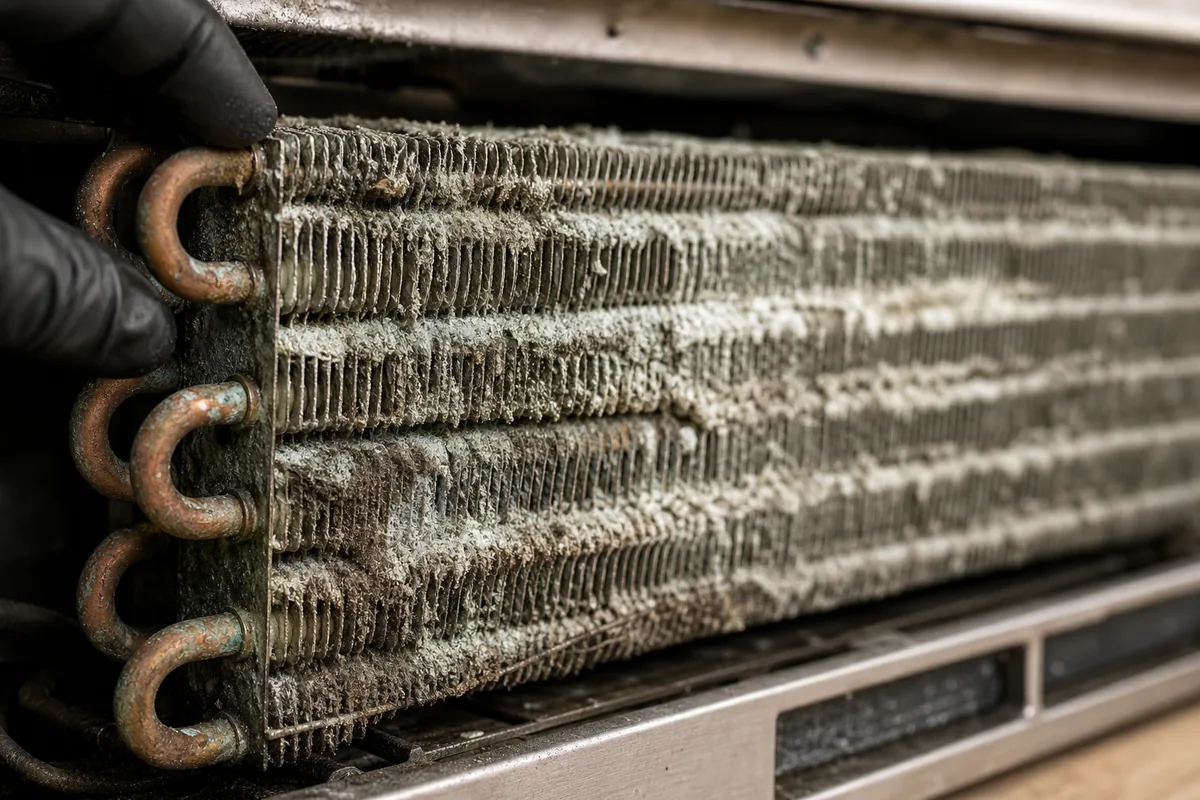
What moves the price, lower end to higher end
| Factor | Lower end | Higher end |
|---|---|---|
| Fault type | Condenser clean, fan, thermistor ($250–$550) | Sealed system or evaporator ($1,500–$3,400) |
| Part availability | Current stock board or valve | Scarce 600-series board, rebuilt and serial-matched |
| Coastal exposure | Inland World Golf Village unit, dust only | Oceanfront Anastasia coil, salt-corroded hardware |
| Access | Front-serviceable built-in, single tech | ~1,000-lb PRO 48 or column pair, two techs |
| Number of stacked faults | One repair, one visit | Locked board plus a fouled condenser, same call |
The dual-compressor PRO economics sit on the PRO series page; the built-in board costs on the BI series page.
Why repair almost always beats replacement on a built-in
The number that reframes every other number here is the cost of replacement. A comparable new Sub-Zero column or 42-inch built-in runs well past $12,000 installed, and because the original unit was set into custom cabinetry framed around its exact dimensions, replacing it often means cabinetry work too. Against that, even the top of our repair ladder is a bargain.
That is why we treat condemnation as a last resort and prove it before we say it. A board, a gasket, an evaporator fan, even a full sealed-system rebuild keeps a unit that was built to be serviced for decades doing exactly that. We recommend replacement only when a unit is already at end of life and the repair approaches a third of new cost. The reasoning, and the ethos behind it, is on our about page; the booking details are on the contact page.
Cost questions owners ask
What does a typical Sub-Zero repair cost in St. Augustine?
Most repairs land between $250 and $1,100. A condenser cleaning or fan service runs $250 to $550; a thermistor, gasket, or thermostat runs $550 to $1,100; an ice-maker descale and valve rebuild runs $300 to $900. The big-ticket work sits above that: a control board $550 to $1,400, a compressor $1,000 to $2,000, and full sealed-system or evaporator work $1,500 to $3,400. We quote the band on the phone and confirm a firm number in writing on arrival.
Do you charge a diagnostic fee, and does it apply to the repair?
A diagnostic visit is real work — reading the rating plate, pulling temperatures and error history, inspecting the condenser, and checking the sealed system — and it ends with a written quote before any repair starts. Ask when you book how the diagnostic is handled relative to the repair; we are straight about it on the call. What we never do is open a part box before you have approved the number.
Why does the same model cost different amounts to repair a few miles apart?
Three things move it: the fault, the part, and the access. A salt-corroded coil on an oceanfront Anastasia unit is a different job than dust on an inland World Golf Village box. A scarce 600-series board that has to be rebuilt and serial-matched costs more than a current stock valve. And a 1,000-pound PRO 48 needing two technicians costs more to access than a front-serviceable built-in. Same model number, different repair story.
Is it cheaper to replace my Sub-Zero than to repair it?
Rarely, on a built-in. A comparable new column or 42-inch built-in runs well past $12,000 installed, and the cabinetry was framed around the original box. Even a $3,000 sealed-system repair is a quarter of that. We steer toward replacement only when a unit is already near end of life and the repair approaches a third of new cost — and we tell you that plainly rather than sell a doomed fix.
Are repair costs higher near the water on Anastasia Island and Vilano Beach?
They can run higher, and the reason is corrosion, not a coastal surcharge. Salt air fouls condensers and corrodes exposed hardware years early, so a beachside unit needs cleaning more often and sometimes hinge or trim replacement an inland unit never would. The base labor is the same; the salt just adds work. Quarterly condenser cleaning near the ocean is the cheapest way to keep the bigger bills away.
Will a twenty-year-old Sub-Zero from a World Golf Village build cost more to fix?
Sometimes a bit more, because older 500 and 600 units occasionally need a board rebuilt or a part sourced rather than pulled from stock. But the repair is almost always worth it — those classics were built to be serviced for decades, and a board or evaporator job is a fraction of a new built-in. The 1998–2008 King & Bear cohort is exactly the housing stock we built the parts bin around.
Does hard water in Palencia make ice-maker repairs more expensive?
It makes them more frequent rather than dramatically more expensive. St. Johns County aquifer water runs 14 to 28 grains per gallon, among the hardest in Florida, and the Palencia and CR-210 corridor sits at the high end. That scale closes inlet valves and clogs fill tubes, so a descale and valve rebuild — $300 to $900 — comes up more often there. A maintenance descale is far cheaper than waiting for the valve to fail outright.
How do you keep the quote honest?
Diagnosis before the price, and the price in writing before the repair. We read the model and serial, measure the fault rather than guess it, and name sealed-system or compressor work only after a refrigerant-side inspection supports it. You approve a firm number before the toolbox opens. We would rather lose a sale than sell a repair that should not happen — that is the whole reason an independent shop survives in a town this size.
Every page on this site
The full set of repair, series, and neighborhood pages for St. Augustine Sub-Zero owners.
- Refrigerator repair
- Freezer repair
- Ice maker repair
- Wine cooler repair
- Sealed system & compressor
- Repair cost guide
- Classic 500 & 600 series
- BI series
- PRO series
- Not cooling after an outage
- Corrosion & rust
- Error codes explained
- Leaking water
- Palencia
- Davis Shores & Anastasia
- World Golf Village
- Book a visit
Durable things deserve care.
Tell us the model and the symptom, and we will arrive with the right parts the first time.